
Supported now
- Use the case as a first-approximation design direction.
- Proceed to detailed CAD/CAE and controlled geometry definition.
- Identify the next validation evidence required.
- Compare the operating point with the first critical family.
Illustrative public Architecture Screen sample · AURA-PS-J15-20K
This sample uses an existing public controlled case to show report structure. It is not a fictional customer project and it does not increase the evidence authority of the underlying case.
2 · Controlled basis
A customer package would also record coordinate basis, gas state, load basis, geometry revision, assumptions, supplied evidence and agreed exclusions.
3 · Bearing result
These coefficients are presented as state-dependent engineering outputs, not portable material properties. Their meaning depends on the attached geometry, clearance, pressure, coordinate convention and method basis.
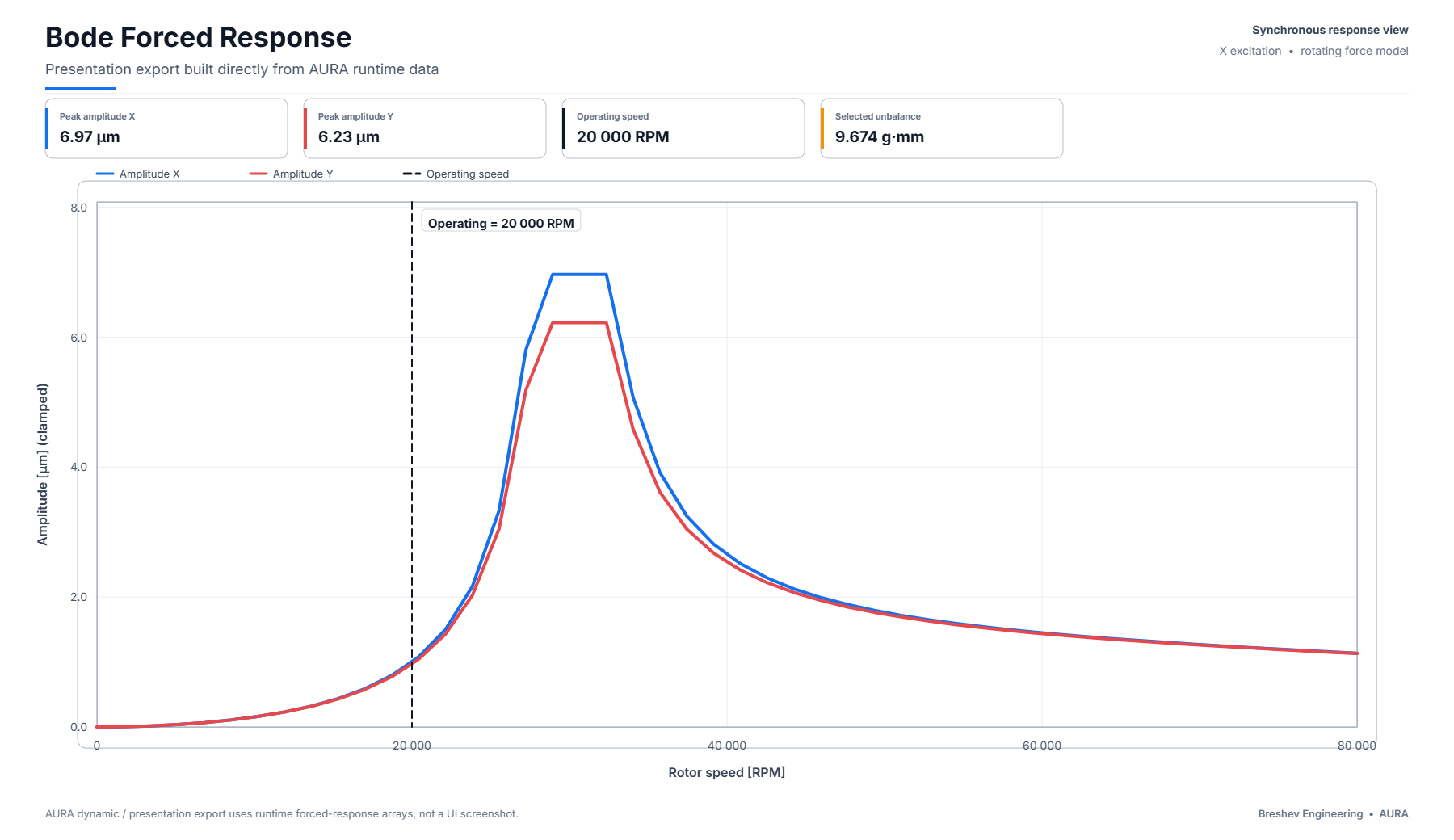
4 · Rotor consequence
The value of the package is the connected chain: bearing state → rotor model → physical consequence → evidence-bounded decision.
5 · Decision basis
The boundary is methodological, not cosmetic. Open the stop-boundary map to see which evidence gaps prevent screening from being promoted into release authority.
Open evidence-boundary map →6 · Required next action
The operating-state evidence map defines the question, target proof, acceptance quantity and re-coupling rule before detailed work starts.
Open acceptance-evidence map →Illustrative sample generated from the public AURA-PS-J15-20K controlled case. Breshev Engineering · AURA Engineering Platform.