
Adjustable conical support architecture
One spindle architecture. Multiple controlled support states.
AURA tests whether controlled changes in clearance, supply and support state can move stiffness, capacity and rotor behaviour far enough to cover several machine duty points.
Controlled support state
The pair is treated as one adjustable engineering object.
Clearance, supply condition, geometry, restrictor configuration and support pairing are not independent marketing features. They define one operating state whose bearing and rotor consequences must remain consistent.
- Radial and axial capacity
- Stiffness matrix and flow
- Minimum clearance and margin
- Natural-frequency / critical-speed consequence
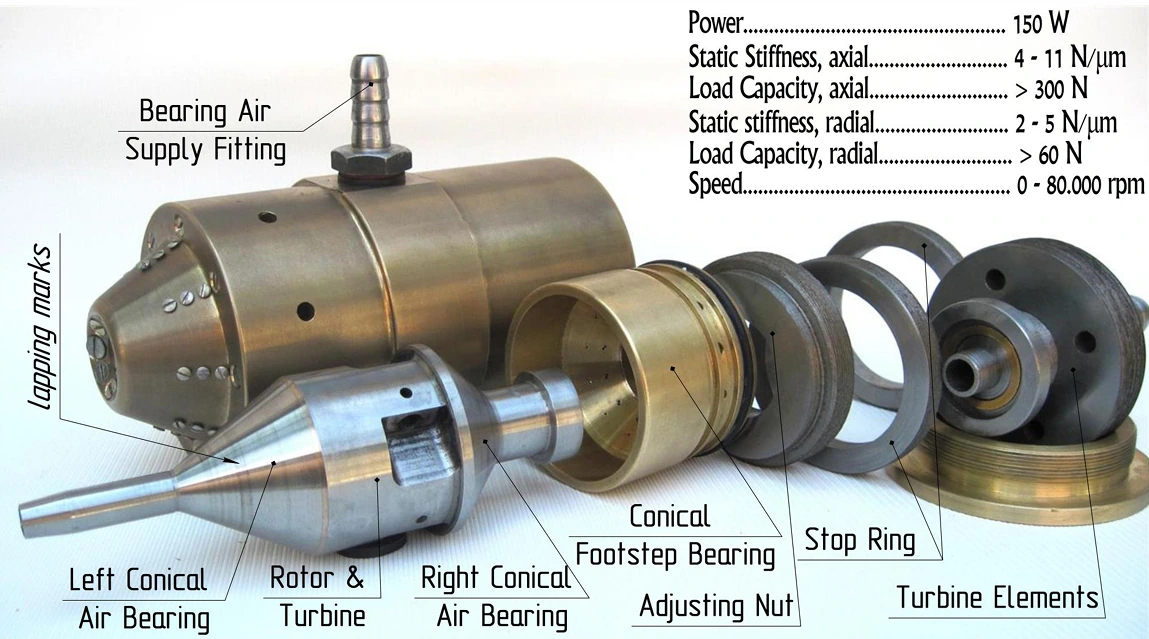
Produced adjustable spindle
Feed geometry changes the pressure field.
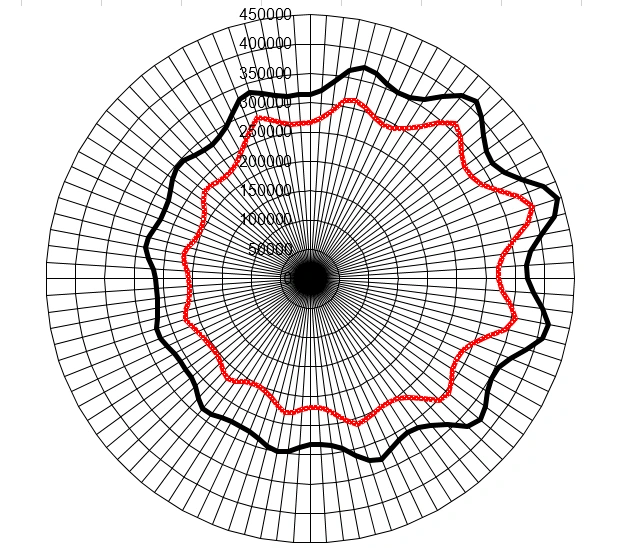
The research chain includes a direct comparison of pressure distribution between feed rows for alternative feed-hole details used in the adjustable-conical spindle programme.
Decision logic
Adjustment is valuable only if the whole machine envelope closes.
Each duty point is screened as a controlled state and carried into the rotor before a decision is made on one adjustable architecture versus several fixed variants.
Define duty points
Loads, RPM, accuracy, envelope and gas constraints.
Synthesise states
Generate feasible support states for each operating zone.
Check bearing physics
Capacity, stiffness, flow, clearance and margin.
Carry into rotor
Mode families, response and critical-speed separation.
Reject weak corners
Expose the state that governs the architecture.
Choose product range
One adjustable spindle, fixed variants or a mixed family.
Define the duty points and test the architecture.
Start with loads, RPM, gas supply, envelope and the operating zones one spindle is expected to cover.